


Patricia Perfas5 min read
Search, filters, and faceted navigation play an important role in the digital customer journey, shaping how customers locate and evaluate products and services. When these discovery tools do not surface relevant results, customers abandon their searches and disengage from the shopping journey.
Industry research estimates that over $300 billion in U.S. retail revenue is forfeited annually due to search abandonment. Much of this friction stems from fragmented product data, which prevents search engines and filters from returning accurate matches.
This article examines how Product Information Management (PIM) enhances search performance and filtering precision by organizing product data to facilitate efficient exploration and informed purchase decisions.
Product and Service Discovery as a Revenue Layer
In ecommerce, how easily customers can find the products and services they need directly impacts conversion and revenue growth.
Research from the Baymard Institute reports that findability influences whether users can identify, assess, and buy items. A separate Baymard study found that 31% of product-finding attempts fall short when users rely on a website’s search functionality, exposing direct revenue risk.
However, when discovery tools perform as intended, the upside is substantial. Visitors who use on-site search are 2-3 times more likely to convert, according to Forrester Research, highlighting the value of effective catalogue navigation.
Product and service discovery is, therefore, tied to business performance. When filters and category browsing guide customers to their desired offerings, organizations benefit from higher conversion rates, accelerated buying decisions, and increased average order value (AOV). Ultimately, sustaining these advantages depends on how well companies manage product information across their digital storefronts.
The Challenges of Fragmented Product Data
Fragmentation occurs when product data varies across systems, suppliers, or catalogue frameworks. These breakdowns stem from data management issues such as:
- Inconsistent naming of product details: prevents systems from aligning queries with the correct product records
- Missing or incomplete specifications: limit the visibility of product information across systems and channels
- Duplicate or mismatched values across systems: create conflicting or redundant records that undermine data integrity
- Supplier data variations: introduce differences in terminology and formatting across product descriptions
- Non-standardized taxonomy and category hierarchies: complicate product organization and catalogue management
- Siloed product data sources: disrupt information flow across customer touchpoints
These conditions distort how product data is structured, stored, and distributed across systems, creating inconsistencies that affect downstream digital experiences.
Consequently, organizations encounter operational and customer-experience impacts such as:
- Data discrepancies across systems: product information appears in different forms depending on where it is accessed
- Reduced confidence in data: differences in product details and availability erode trust
- Increased effort during product evaluation: customers must spend more time verifying item specifications
- Operational complexity: teams must manually reconcile data across systems and channels
- Disconnected experiences across channels: customers encounter varying information across digital environments
Over time, these data challenges compound as product assortments expand, increasing operational demands and undermining the overall customer experience.
In turn, these constraints can be addressed with product information management software, which centralizes, standardizes, and governs product data to create a unified data foundation across systems and channels.
How PIM Creates a Discovery-Ready Data Foundation
With consistent product data in place, organizations can begin to define the attributes, taxonomy, and enrichment processes that power product information across digital channels.
Building on this foundation, product data enrichment improves the depth and quality of product records, while controlled distribution ensures trusted information reaches commerce platforms, search systems, and other digital channels. Together, these practices strengthen data oversight and support the expansion of product and service portfolios without increasing operational complexity.
Within a product information management system, discovery-ready product data is supported through functions such as:
- Defining offering details so information is structured consistently across catalogues
- Enriching product records with detailed specifications and media assets
- Governing product data to maintain quality and alignment as portfolios scale
- Synchronizing product information across commerce platforms, search systems, and online channels
As a result, PIM helps search, filtering, and navigation surface relevant information more effectively as product and service portfolios expand.
Transforming Search, Filtering & Faceted Navigation
Product information management software enables organizations to manage product information across their catalogues, supporting the search, refinement, and navigation capabilities required for effective product and service discovery. This includes:
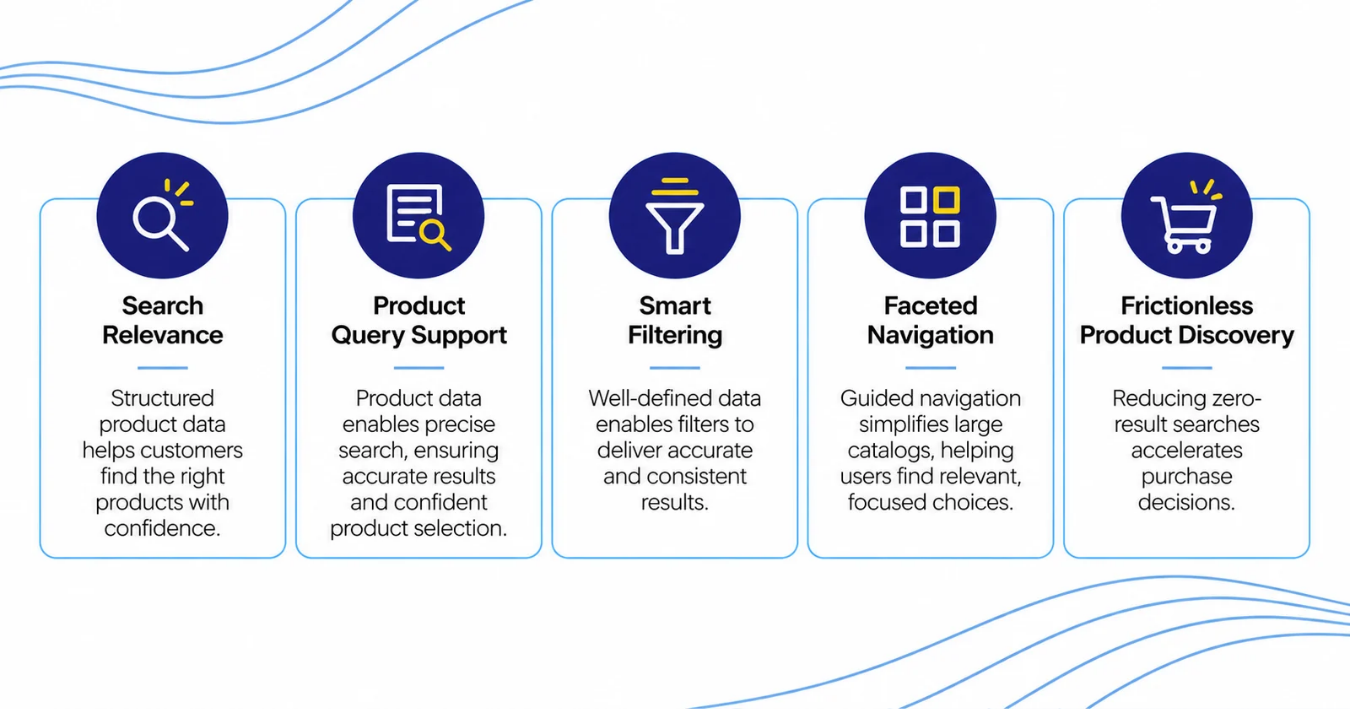
- Relevant Search Results: Accurate data helps search systems present the right products, reducing zero-result searches and allowing customers to locate what they need.
- Product Matching: Detailed product and service descriptions facilitate the connection between customer queries and appropriate offerings.
- Filtering: Standardized data supports shoppers in narrowing results based on relevant characteristics.
- Faceted Navigation: A defined catalogue structure enables exploration of large selections and identification of suitable options.
- Consistent Product Discovery: Centralized product information ensures the same product and service details across digital channels.
Additionally, enriched product data support search systems in interpreting user intent beyond basic keyword matching, improving results for both targeted searches and exploratory browsing. Consistent data values ensure filters reflect product distinctions rather than conflicting entries.
Moreover, faceted navigation provides structured pathways through product catalogues, guiding users across attributes such as size, compatibility, material, or use case to simplify product sets into manageable comparisons.
Together, these capabilities enhance how offerings are surfaced and evaluated across product and service portfolios.
Business Outcomes with Product Information Management
Organizations using product information management software such as Akeneo and inriver to improve ecommerce search, filtering, and faceted navigation demonstrate outcomes such as:
- ASSA ABLOY increased page views by 27%, reduced exits by 16%, and cut support calls by 20% after improving data quality.
- N Brown addressed search usability and attribute inconsistencies by centralizing product information, enabling customers to locate and evaluate items more efficiently.
- W.B. Mason accelerated time-to-market by 67% while enriching product data across 100,000 SKUs.
- Vertiv unified its global catalogues, enabling discovery and specification-based navigation across channels in 130 countries.
Collectively, these outcomes illustrate how Product Information Management (PIM) influences how offerings are surfaced, refined, and explored in digital experiences.
Tidal brings consulting, engineering, managed services, and agentic solutions together under one team to solve complex digital transformation challenges across the enterprise. Our Unified Commerce solutions help organizations connect customer experiences with the platforms, data, and processes behind them. For retail and consumer goods businesses, stronger product information management can improve search accuracy, filtering, and product discovery across digital storefronts. If you would like to discuss how stronger product information management can support your organization, connect with us.